

Introduction
Artificial Intelligence is no longer a future technology. It is already transforming how businesses operate, communicate, analyse data, automate workflows, and serve customers. From AI-powered chatbots and recommendation engines to advanced business intelligence platforms, organisations are rapidly integrating AI into their daily operations.
However, there is a growing concern that many businesses are focusing on AI adoption while overlooking one critical factor—security.
A powerful AI system without proper security controls can expose sensitive data, create compliance risks, generate inaccurate outputs, and even become a target for cyberattacks. As AI becomes deeply embedded in business processes, securing these systems is no longer optional. It is a business necessity.
Organisations that build secure AI systems from the beginning gain more than protection. They build customer trust, ensure regulatory compliance, reduce operational risks, and create a stronger foundation for long-term innovation.
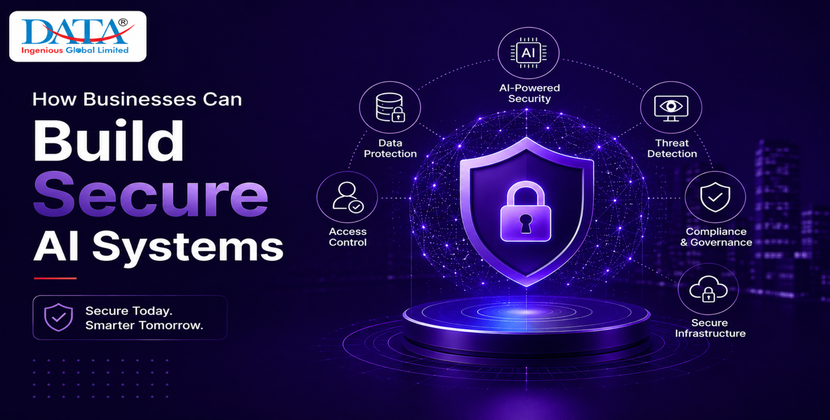
In this guide, we will explore how businesses can build secure AI systems, the risks they need to address, and the best practices that can help create safe, reliable, and responsible AI solutions.
Why AI Security Matters More Than Ever
Businesses today generate and process massive amounts of data. AI systems often rely on this data to learn, predict, and make decisions. The challenge is that the same data powering AI can also become a vulnerability if not properly protected.
Imagine an organisation using AI to analyse customer information, financial records, or proprietary business data. A security weakness in the AI model or infrastructure could expose confidential information, leading to financial losses, reputational damage, and regulatory penalties.
The rapid rise of generative AI has further increased security concerns. Employees are using AI tools to create content, automate tasks, and analyse information. Without clear governance and security policies, sensitive company information may unintentionally be shared with external AI platforms.
This is why enterprise AI security has become a boardroom discussion rather than just an IT concern. Businesses need a comprehensive strategy that secures data, models, infrastructure, and user access throughout the AI lifecycle.
Understanding the Security Risks in AI Systems
Before implementing security measures, organisations must understand the most common risks associated with AI deployments.
Data Privacy and Data Leakage Risks
AI systems depend heavily on data. If training datasets contain confidential customer information, intellectual property, or business-sensitive records, improper handling can create serious privacy concerns.
Data leakage can occur during training, testing, deployment, or even through user interactions with AI applications. Once sensitive information is exposed, recovering trust becomes difficult.
Businesses must ensure that all data used for AI ML development follows strict privacy standards and regulatory requirements.
Model Manipulation and Adversarial Attacks
Cybercriminals are increasingly targeting AI models themselves. Through adversarial attacks, malicious actors can manipulate inputs to trick AI systems into making incorrect decisions.
For example, an attacker may alter data in a way that causes an AI-powered fraud detection system to miss fraudulent transactions or approve suspicious activities.
Such attacks highlight the importance of robust model testing and continuous monitoring.
Prompt Injection and Generative AI Threats
Generative AI applications face unique security challenges. Attackers may use prompt injection techniques to bypass safeguards, manipulate outputs, or access restricted information.
As businesses deploy AI assistants, customer service bots, and enterprise AI applications, prompt security becomes an essential component of overall AI security strategy.
Compliance and Regulatory Risks
Governments and regulatory bodies worldwide are introducing stricter AI regulations. Businesses that fail to implement proper governance and security controls may face compliance violations and legal consequences.
Secure AI development must include compliance considerations from the very beginning rather than treating them as an afterthought.
Building Security into AI from Day One
One of the biggest mistakes organisations make is treating security as something that can be added after an AI solution is developed.
In reality, security should be integrated throughout the entire AI lifecycle.
Adopt a Security-by-Design Approach
Security-by-design means incorporating security requirements at every stage of AI development.
Instead of building an AI model first and securing it later, organisations should evaluate risks during planning, development, testing, deployment, and maintenance.
This approach helps identify vulnerabilities early when they are easier and less expensive to fix.
A security-first mindset reduces exposure and improves overall system resilience.
Establish Clear AI Governance
AI governance provides the framework that guides how AI systems are developed, deployed, and managed.
Effective governance includes:
- Defined ownership and accountability
- Security policies for AI usage
- Risk assessment procedures
- Compliance monitoring
- Ethical AI guidelines
Governance ensures consistency while helping organisations manage security risks proactively.
Protect Data Throughout the AI Lifecycle
Data is the foundation of every AI system. Protecting it should be a top priority.
Secure Data Collection
Businesses should collect only the data necessary for achieving specific objectives. Excessive data collection increases risk and creates unnecessary exposure.
Organisations must also verify the quality, accuracy, and legitimacy of data sources before using them for training AI models.
Encrypt Sensitive Information
Encryption helps protect data both at rest and in transit.
Whether data is stored in databases, cloud environments, or AI training repositories, encryption significantly reduces the impact of potential breaches.
Modern enterprise AI security strategies rely heavily on strong encryption standards to safeguard valuable information.
Implement Data Access Controls
Not every employee requires access to AI training datasets or production models.
Role-based access control helps ensure that users only access the information necessary for their responsibilities.
Limiting access reduces insider threats and strengthens overall security posture.
Secure AI Model Development and Training
The development phase plays a critical role in determining the security and reliability of AI systems.
Validate Training Data Carefully
AI models learn from the data they receive. If training datasets contain inaccurate, manipulated, or biased information, the model's outputs may become unreliable.
Organisations should implement rigorous validation processes to verify data quality before training begins.
Regular audits can help identify anomalies and improve model performance.
Test Models Against Security Threats
Just as traditional software undergoes security testing, AI models should be evaluated against potential attack scenarios.
Security testing may include:
- Adversarial testing
- Model robustness evaluation
- Bias assessment
- Stress testing
- Output validation
Comprehensive testing helps uncover vulnerabilities before attackers do.
Monitor Model Drift
AI systems evolve over time as new data becomes available.
Model drift occurs when real-world conditions change and the model's performance declines.
Continuous monitoring helps organisations detect unusual behaviour, maintain accuracy, and identify potential security concerns early.
Implement Strong Identity and Access Management
Many AI security incidents occur because of weak access controls rather than flaws in the AI model itself.
Enforce Multi-Factor Authentication
Multi-factor authentication adds an additional layer of protection by requiring multiple verification methods before granting access.
This simple measure significantly reduces the risk of unauthorised access.
Apply the Principle of Least Privilege
Employees, developers, and third-party vendors should only receive the minimum level of access required to perform their duties.
This limits potential damage if an account is compromised.
Review Permissions Regularly
As organisations grow, access permissions often become outdated.
Regular reviews help remove unnecessary privileges and maintain a secure environment.
Build Responsible AI Alongside Secure AI
Security and responsibility go hand in hand.
An AI system that is technically secure but produces biased or harmful outcomes can still create significant business risks.
Focus on Transparency
Users should understand how AI systems are being used and what role they play in decision-making processes.
Transparency builds trust and supports regulatory compliance.
Reduce Bias in AI Models
Bias can emerge from training data, model design, or operational processes.
Businesses should continuously evaluate outputs to ensure fairness and prevent discrimination.
Responsible AI practices improve both security and reliability.
Maintain Human Oversight
AI should support human decision-making rather than completely replace it in high-risk scenarios.
Human review remains essential for critical decisions involving finance, healthcare, recruitment, legal matters, and customer data.
Strengthen Cloud and Infrastructure Security
Most modern AI applications operate in cloud environments.
While cloud platforms offer scalability and flexibility, they also introduce new security considerations.
Secure Cloud Configurations
Misconfigured cloud resources remain one of the leading causes of data breaches.
Organisations should regularly audit cloud environments to identify vulnerabilities and enforce security standards.
Monitor Network Activity
Continuous monitoring helps detect suspicious behaviour before it escalates into a major incident.
Advanced threat detection solutions can identify unusual access patterns and respond quickly.
Keep Systems Updated
Outdated software often contains known vulnerabilities that attackers actively exploit.
Regular updates and patch management are essential for maintaining secure AI systems.
Develop an AI Incident Response Strategy
Even the most secure organisations may face security incidents.
Preparation determines how effectively a business can respond and recover.
A comprehensive AI incident response plan should include:
- Threat detection procedures
- Escalation workflows
- Investigation processes
- Recovery plans
- Communication protocols
Regular simulations and security exercises help teams respond faster during real incidents.
Businesses that prepare in advance minimise downtime and reduce the impact of potential breaches.
The Future of Enterprise AI Security
As AI adoption continues to accelerate, security challenges will become more sophisticated.
Emerging technologies such as autonomous AI agents, multimodal AI systems, and advanced generative AI applications will introduce new attack surfaces and risk factors.
Businesses that invest in secure AI development today will be better prepared for tomorrow's challenges.
Future-ready organisations are already focusing on:
- AI governance frameworks
- Responsible AI implementation
- Zero-trust security models
- Automated threat detection
- Continuous AI monitoring
- Regulatory compliance readiness
Security will increasingly become a competitive advantage rather than simply a compliance requirement.
Conclusion
AI has the power to transform businesses, improve efficiency, and unlock new growth opportunities. However, the value of AI depends on trust, reliability, and security.
Building secure AI systems requires more than installing security tools. It demands a strategic approach that protects data, secures models, strengthens infrastructure, enforces governance, and promotes responsible AI practices.
Organisations that prioritise AI security from the beginning are better positioned to reduce risks, maintain compliance, protect customer trust, and scale AI initiatives with confidence.
As AI becomes a core part of modern business operations, secure AI product development is no longer a technical recommendation—it is a business imperative.
Ready to Build Secure AI Solutions for Your Business?
At Data.in, we help organisations design, develop, and deploy secure, scalable, and responsible AI solutions tailored to business needs. Whether you are exploring AI adoption or strengthening existing AI systems, our experts can help you build a future-ready AI strategy with security at its core.
Connect with Data.in today and discover how secure AI can accelerate innovation while protecting what matters most.