

How Businesses Are Integrating AI Into Existing Software
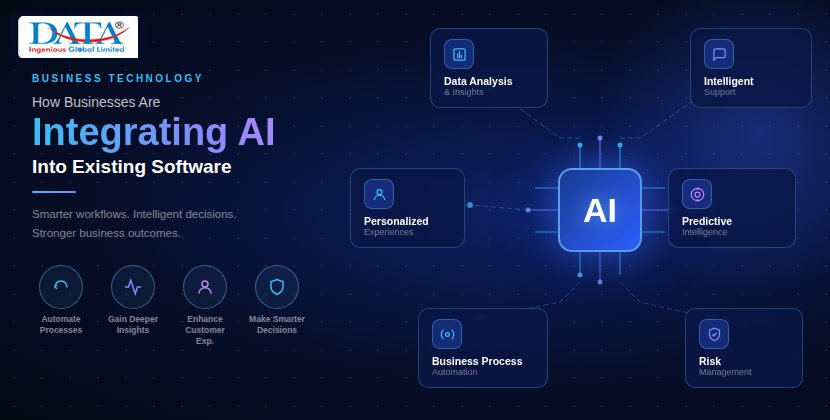
Introduction
Artificial Intelligence is no longer a futuristic concept reserved for tech giants. Today, businesses of every size are finding practical ways to integrate AI into the software they already use. Instead of replacing existing systems, organisations are enhancing them with AI capabilities that improve efficiency, automate repetitive tasks, and provide smarter decision-making support.
From CRM platforms and ERP systems to customer support tools and enterprise applications, AI integration is transforming how businesses operate. Companies that successfully adopt AI are not just reducing operational costs—they are creating better customer experiences, improving productivity, and gaining a competitive advantage in increasingly digital markets.
The real question is no longer whether businesses should adopt AI. The focus has shifted to how businesses can integrate AI into existing software in a way that delivers measurable business value.
In this guide, we will explore why AI integration is becoming essential, how companies are implementing it, common challenges, and the strategies that are helping organisations succeed in their AI transformation journey.
Why AI Integration Has Become a Business Priority
Over the last few years, businesses have generated massive amounts of data. However, data alone does not create value. The ability to analyse, understand, and act on that data quickly is what drives business growth.
This is where AI-powered software plays a crucial role.
Traditional software systems are excellent at storing information and executing predefined processes. AI takes these capabilities further by enabling software to learn from patterns, generate insights, predict outcomes, and automate decisions.
As customer expectations continue to rise and competition becomes more intense, organisations are under pressure to operate faster and smarter. AI integration helps businesses meet these demands without completely rebuilding their existing technology infrastructure.
Many organisations are discovering that adding AI capabilities to their current software is often more cost-effective and less disruptive than replacing entire systems.
Understanding AI Integration in Existing Software
AI integration refers to embedding artificial intelligence technologies into existing software applications to enhance their functionality and performance.
Rather than creating entirely new systems from scratch, businesses are incorporating AI features into tools they already use every day.
For example:
- A CRM platform can use AI to predict customer behaviour.
- An HR management system can automatically screen job applications.
- A customer support platform can deploy AI chatbots to handle routine queries.
- An ERP system can forecast inventory demand more accurately.
- A marketing platform can personalise campaigns based on user behaviour.
The goal is to make existing software more intelligent, efficient, and responsive while preserving the workflows employees are already familiar with.
The Growing Role of AI in Business Software
The adoption of AI in business software has accelerated rapidly due to advancements in machine learning, natural language processing, computer vision, and generative AI.
Businesses are now leveraging AI across multiple functions, including:
Customer Service
AI-powered chatbots and virtual assistants provide instant responses to customer inquiries, reducing support workloads and improving response times.
Modern AI systems can understand context, analyse sentiment, and offer personalised assistance, creating more satisfying customer interactions.
Sales and CRM
Sales teams are using AI to identify high-potential leads, forecast sales performance, and recommend next-best actions.
AI helps sales professionals spend less time on administrative work and more time building customer relationships.
Human Resources
Recruitment platforms now use AI to analyse resumes, match candidates with job requirements, and streamline hiring processes.
AI also supports employee engagement, performance analysis, and workforce planning.
Finance and Accounting
Businesses are integrating AI into financial software to automate invoice processing, detect fraud, predict cash flow trends, and improve financial reporting accuracy.
Marketing Automation
AI helps marketers create personalised experiences, optimise advertising campaigns, analyse customer behaviour, and generate content recommendations.
These applications demonstrate how AI is becoming a core component of intelligent business applications across industries.
How Businesses Are Integrating AI Into Existing Software
Successful AI integration is not simply about adding new technology. It requires a strategic approach that aligns with business objectives.
Identifying High-Impact Use Cases
The first step is identifying areas where AI can solve meaningful business problems.
Organisations often begin by analysing repetitive tasks, operational bottlenecks, customer service challenges, or data-intensive processes.
Instead of trying to transform every workflow simultaneously, successful companies focus on specific use cases that can deliver quick wins and measurable ROI.
For example, a customer support team may implement AI-powered ticket categorisation before expanding AI capabilities into broader customer service operations.
This phased approach reduces risk while building organisational confidence in AI adoption.
Leveraging APIs and AI Platforms
Modern AI software development has become significantly easier thanks to cloud-based AI platforms and APIs.
Businesses can integrate AI services into existing applications without building complex machine learning models from scratch.
These services provide capabilities such as:
- Natural language processing
- Speech recognition
- Image analysis
- Predictive analytics
- Recommendation engines
- Generative AI functionality
By using pre-built AI models, organisations can accelerate implementation while reducing development costs.
Embedding AI into Existing Workflows
One common mistake organisations make is introducing AI as a completely separate system.
The most successful AI implementation strategies focus on integrating AI directly into existing workflows.
Employees are more likely to adopt AI when it enhances the tools they already use rather than forcing them to learn entirely new systems.
For example, AI-generated insights can appear directly within CRM dashboards, project management tools, or customer support platforms.
This seamless experience encourages adoption and maximises business value.
Using Generative AI Capabilities
The rise of generative AI has created new opportunities for software enhancement.
Businesses are integrating generative AI features into enterprise applications to assist with:
- Content creation
- Customer communications
- Knowledge management
- Report generation
- Code development
- Document summarisation
These capabilities improve productivity while reducing the time required for routine knowledge-based tasks.
Key Benefits of AI-Powered Software
The growing popularity of AI integration is driven by tangible business benefits.
Improved Operational Efficiency
One of the biggest advantages of AI-powered software is its ability to automate repetitive and time-consuming tasks.
Employees can focus on strategic work while AI handles routine processes such as data entry, scheduling, reporting, and information retrieval.
This leads to faster operations and increased productivity.
Better Decision-Making
AI systems can analyse large datasets far more quickly than humans.
By identifying trends, patterns, and anomalies, AI provides business leaders with valuable insights that support informed decision-making.
Predictive analytics helps organisations anticipate future outcomes rather than simply reacting to historical data.
Enhanced Customer Experience
Modern customers expect personalised interactions and rapid service.
AI enables businesses to deliver both.
From intelligent chatbots to personalised product recommendations, AI improves customer engagement while increasing satisfaction and loyalty.
Cost Reduction
Automation reduces manual effort and operational expenses.
Businesses can handle higher workloads without proportionally increasing staffing costs, resulting in improved profitability.
Competitive Advantage
Organisations that successfully integrate AI often gain a significant edge over competitors.
They can innovate faster, respond more quickly to market changes, and deliver superior customer experiences.
Common Challenges in AI Integration
Despite its benefits, integrating AI into existing software presents several challenges.
Data Quality Issues
AI systems depend on high-quality data.
If business data is incomplete, outdated, or inconsistent, AI performance will suffer.
Before implementing AI, organisations should invest in data cleansing, governance, and management practices.
Legacy System Limitations
Many businesses operate on legacy software that was not designed to support modern AI technologies.
Integration may require system upgrades, middleware solutions, or infrastructure improvements.
Security and Compliance Concerns
As AI systems process large amounts of business and customer data, security becomes a critical consideration.
Organisations must ensure compliance with data privacy regulations while implementing strong cybersecurity controls.
Responsible AI practices should be incorporated throughout the development and deployment process.
Employee Adoption
Technology alone does not guarantee success.
Employees need training and support to understand how AI can enhance their work rather than replace it.
Building trust and promoting AI literacy are essential components of successful adoption.
Best AI Implementation Strategies for Businesses
Companies that achieve successful outcomes often follow a structured implementation approach.
Start Small and Scale Gradually
Rather than launching enterprise-wide AI initiatives immediately, businesses should begin with focused pilot projects.
Early successes help demonstrate value and build momentum for larger AI investments.
Align AI with Business Objectives
AI should solve real business challenges rather than being implemented simply because it is trendy.
Every AI project should have clear goals, measurable outcomes, and defined success metrics.
Prioritise Data Readiness
High-quality data is the foundation of effective AI systems.
Businesses should establish strong data governance frameworks before scaling AI initiatives.
Maintain Human Oversight
AI should support human decision-making rather than completely replacing it.
Human review remains important for high-risk decisions involving customers, finances, compliance, or legal matters.
Measure and Optimise Continuously
AI implementation is an ongoing process.
Businesses should continuously monitor performance, gather feedback, and refine models to maximise effectiveness.
Real-World Examples of Enterprise AI Solutions
Across industries, organisations are successfully integrating AI into existing software environments.
Retail companies use AI to forecast demand, optimise inventory levels, and personalise shopping experiences.
Healthcare providers leverage AI to analyse medical records, improve diagnostics, and streamline administrative workflows.
Financial institutions integrate AI into fraud detection systems, risk management platforms, and customer service applications.
Manufacturing companies use AI-powered analytics to predict equipment failures and improve operational efficiency.
These examples highlight how enterprise AI solutions are creating measurable business value across diverse sectors.
The Future of Digital Transformation with AI
The next phase of digital transformation will be heavily driven by AI.
Businesses are moving beyond simple automation toward intelligent systems capable of reasoning, learning, and adapting in real time.
Emerging trends include:
AI Agents
Autonomous AI agents are expected to handle increasingly complex business tasks, from customer service to workflow management.
Hyper-Personalisation
AI will enable businesses to deliver highly customised experiences based on individual customer preferences and behaviour.
AI-Driven Decision Intelligence
Advanced analytics platforms will provide predictive and prescriptive recommendations, helping leaders make faster and smarter decisions.
Industry-Specific AI Solutions
Organisations will increasingly adopt specialised AI applications tailored to their unique industry requirements.
Companies that invest in AI today will be better positioned to capitalise on these future opportunities.
Conclusion
AI integration is no longer an experimental initiative reserved for technology leaders. It has become a practical business strategy for organisations seeking greater efficiency, improved customer experiences, and sustainable growth.
By integrating AI into existing software, businesses can unlock new levels of productivity without replacing their current systems. Whether through automation, predictive analytics, intelligent recommendations, or generative AI capabilities, the opportunities are substantial.
The key to success lies in starting with clear business objectives, prioritising data quality, implementing AI responsibly, and focusing on measurable outcomes.
As digital transformation continues to accelerate, businesses that embrace AI-powered software today will be better equipped to compete, innovate, and thrive in the years ahead.
Ready to Build Smarter Business Software?
At Data.in, we help organisations leverage modern AI technologies to transform business operations, automate workflows, and unlock actionable insights. Explore our AI solutions and discover how intelligent software can drive your next phase of growth and innovation.