

Introduction
The software industry is not entering the AI era. It is already inside it.
The only question now is simple: will your product evolve fast enough to survive?
Modern businesses no longer want software that only stores data or manages workflows. They want systems that think, predict, automate, recommend, and continuously improve. That is exactly why AI-First Products are becoming the new standard across industries.
From enterprise automation platforms to intelligent SaaS tools, AI is moving from an “extra feature” to the core foundation of software design. Companies that build around AI from day one are scaling faster, reducing operational costs, and delivering dramatically better user experiences than legacy platforms.
In this article, we will explore why AI-First Products will dominate the software industry, how enterprises are adopting them, the technologies powering this shift, and what businesses must do to stay competitive in the next decade.
A Simple Scenario: AI-First vs Legacy Software
Imagine two HR software companies competing for the same enterprise client.
The first company offers a traditional dashboard-based platform. HR teams manually review resumes, schedule interviews, and generate reports.
The second company offers an AI-first platform. It automatically screens resumes, predicts candidate fit, schedules interviews using AI agents, generates hiring insights, and reduces recruiter workload by 70%.
Which platform wins?
In today’s market, the answer is obvious.
This is exactly why investors, enterprises, and product leaders are prioritising AI Product Development at an unprecedented pace.
What Does “AI-First Products” Mean?
AI-First Products Defined
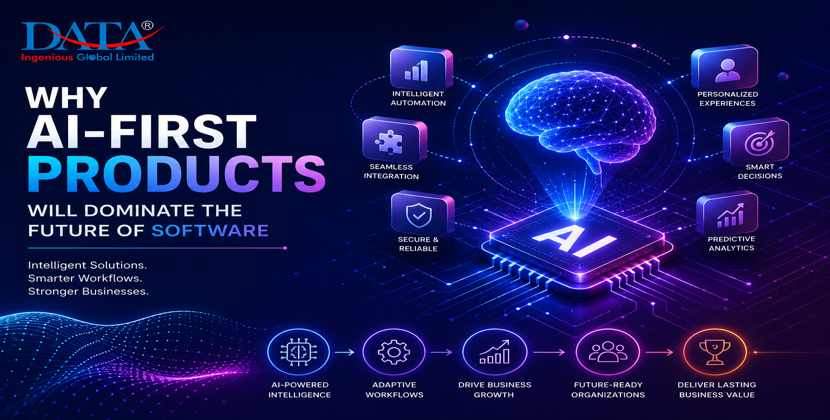
AI-First Products are software solutions designed with artificial intelligence as the core architecture not as an afterthought or add-on feature.
Instead of simply automating fixed workflows, these products continuously learn from user behaviour, data patterns, and interactions to improve outcomes over time.
Traditional software follows predefined rules.
AI-first software adapts dynamically.
Characteristics of AI-First Products
- Built around machine learning or generative AI capabilities
- Use data continuously to improve performance
- Deliver predictive and personalised experiences
- Integrate AI agents and automation workflows
- Reduce manual decision-making
- Scale intelligently with user behaviour
Examples include:
- AI customer support platforms
- Intelligent CRM systems
- AI-powered coding assistants
- Automated cybersecurity tools
- Predictive healthcare platforms
- AI finance and analytics software
“The next generation of software will not just respond to commands. It will anticipate intent.”
Why AI-First Products Will Dominate the Software Industry
1. Enterprises Want Speed and Efficiency
Businesses today operate in highly competitive markets where speed directly impacts revenue.
AI-powered software can automate repetitive tasks, reduce operational delays, and improve decision-making in real time.
According to McKinsey, generative AI could contribute up to $4.4 trillion annually to the global economy through productivity improvements.
That number alone explains why enterprise AI investments are growing aggressively.
Real Impact of AI Automation
- Customer service response times reduced by 60–80%
- Manual reporting workload reduced by 70%
- Faster product recommendations and personalization
- Reduced hiring and operational costs
- Improved fraud detection and cybersecurity response
Companies adopting AI Automation are not simply saving time. They are reshaping entire business models.
2. User Expectations Have Changed Forever
Users now expect software to be intelligent.
People are already interacting daily with recommendation engines, AI chatbots, voice assistants, and AI search tools. Static interfaces feel outdated.
Modern users expect:
- Predictive suggestions
- Personalised workflows
- Natural language interactions
- AI-generated insights
- Faster support experiences
This shift is forcing software companies to redesign products around intelligence rather than menus and dashboards.
3. AI SaaS Products Scale Faster
Traditional SaaS businesses require large operational teams to scale customer support, onboarding, and analytics.
AI SaaS platforms automate many of these layers.
This creates:
- Lower operating costs
- Higher margins
- Faster customer onboarding
- Improved retention rates
That is why investors are increasingly funding AI-Powered Software startups over conventional SaaS platforms.
4. AI Agents Are Becoming Digital Employees
One of the biggest shifts happening right now is the rise of AI Agents.
AI agents can:
- Execute workflows autonomously
- Handle customer queries
- Manage scheduling
- Generate reports
- Coordinate tasks across systems
Instead of requiring human intervention for every process, enterprises are beginning to deploy AI systems that operate independently within defined rules.
This is transforming software from a passive tool into an active business participant.
“The future of enterprise software is not dashboards. It is autonomous execution.”
Key Components of Successful AI-First Products
Strong Data Strategy
AI systems are only as effective as the data powering them.
Successful AI Product Development starts with:
- Clean structured data
- Real-time pipelines
- Governance frameworks
- Data privacy controls
Poor data quality creates inaccurate outputs, biased recommendations, and unreliable automation.
Model Infrastructure and MLOps
Modern enterprise AI requires:
- Continuous model monitoring
- Retraining pipelines
- Performance tracking
- Secure deployment systems
This operational layer is often called MLOps.
Without proper MLOps, AI systems become unstable over time due to model drift and changing data patterns.
Generative AI Integration
Generative AI is dramatically expanding what intelligent software can do.
Today’s AI-powered platforms can:
- Write reports
- Generate code
- Create marketing content
- Summarise meetings
- Analyse customer feedback
- Generate insights instantly
Businesses integrating Generative AI into workflows are creating major productivity advantages.
AI Agents and Workflow Orchestration
AI-first platforms increasingly combine:
- Language models
- APIs
- Workflow engines
- Memory systems
- Autonomous decision layers
This creates intelligent systems capable of multi-step reasoning and execution.
Business Benefits for Enterprises
Higher Productivity
AI-powered workflows reduce repetitive work and allow teams to focus on strategic tasks.
Examples:
- Sales teams spend less time on CRM updates
- HR teams automate candidate screening
- Finance teams automate invoice processing
Better Decision-Making
Intelligent software can analyse massive datasets faster than humans.
This enables:
- Predictive forecasting
- Risk analysis
- Real-time recommendations
- Operational optimisation
Lower Operational Costs
AI Automation reduces dependence on manual processes.
Enterprises adopting AI-first systems often see:
- Reduced support costs
- Lower staffing overhead
- Faster turnaround times
- Increased output per employee
Improved Customer Experience
Customers now prefer:
- Instant responses
- Personalised recommendations
- Faster issue resolution
AI-first businesses consistently deliver better customer satisfaction metrics.
“Customers no longer compare your software with competitors. They compare it with the smartest digital experience they have ever had.”
Common Pitfalls and How to Avoid Them
Poor Data Governance
AI systems trained on poor-quality data produce unreliable outputs.
Solution:
- Implement strong data validation processes
- Create governance frameworks
- Regularly audit training datasets
AI Bias and Ethical Risks
Bias in training data can lead to discriminatory outputs.
Solution:
- Use diverse datasets
- Conduct fairness testing
- Maintain human review systems
Model Drift
AI models degrade over time as user behaviour changes.
Solution:
- Monitor model accuracy continuously
- Retrain models periodically
- Use feedback loops
Overengineering AI
Not every workflow requires complex AI.
Many businesses fail because they force AI into problems that simple automation could solve more efficiently.
Solution:
Start with business problems, not AI hype.
Roadmap to Build an AI-First Product
Phase 1: Identify High-Impact Use Cases
Focus on workflows with:
- Repetitive manual tasks
- Large data volumes
- High operational costs
- Decision-making bottlenecks
Sample KPI Targets
- Reduce processing time by 40%
- Improve customer response speed by 60%
- Reduce manual workload by 50%
Phase 2: Build Data Infrastructure
Create:
- Centralised data pipelines
- API integrations
- Governance frameworks
- Security layers
Phase 3: Deploy AI Models
Introduce:
- Recommendation systems
- Predictive analytics
- Generative AI tools
- AI agents
Start small and scale gradually.
Phase 4: Monitor and Optimise
Track:
- Model accuracy
- User engagement
- Cost savings
- Productivity gains
- Customer satisfaction
AI-first systems improve continuously through iteration.
The Future: AI Agents, Generative AI and the Next Wave
The next generation of software will become increasingly autonomous.
We are moving toward:
- Self-operating enterprise systems
- AI copilots for every department
- Autonomous workflow execution
- Hyper-personalised software experiences
AI agents will likely become standard components inside enterprise platforms.
Generative AI will continue transforming:
- Software development
- Marketing
- Customer support
- Operations
- Analytics
In the next five years, the distinction between “software company” and “AI company” may disappear entirely.
Because eventually, every successful software product will need intelligence at its core.
Conclusion
The software industry is undergoing one of the biggest transformations in its history.
AI-First Products are no longer experimental innovations. They are becoming the competitive standard for enterprises, startups, and SaaS companies worldwide.
Businesses adopting intelligent software today are gaining:
- Faster execution
- Lower operational costs
- Better customer experiences
- Higher scalability
- Stronger competitive advantage
Meanwhile, companies relying solely on legacy software models risk becoming irrelevant.
The future belongs to products that can think, learn, adapt, and automate.
And that future is arriving faster than most businesses expect.