

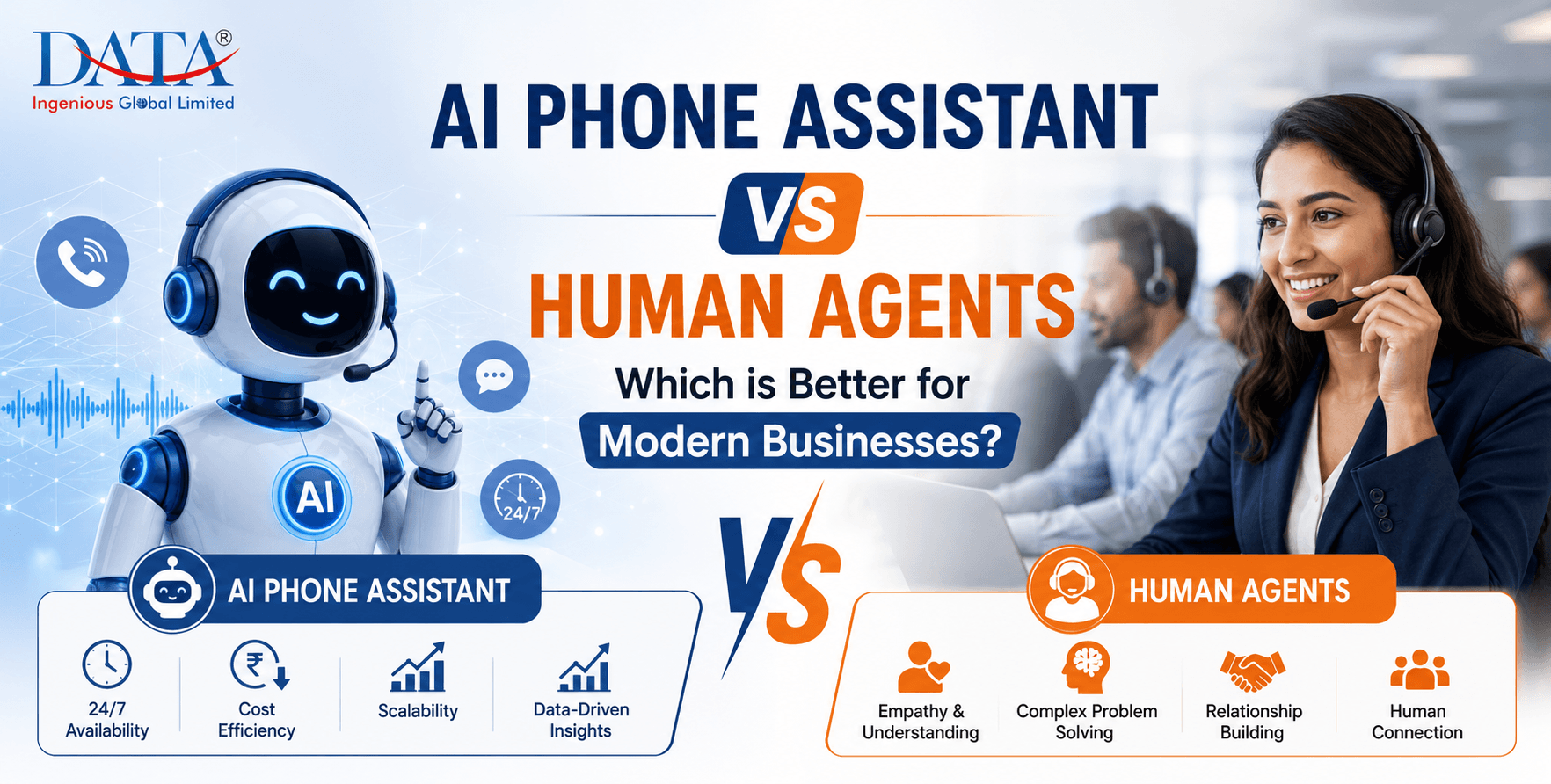
Introduction: The New Era of Customer Conversations
Customer communication is no longer limited to traditional call centers and human-only support teams. Businesses today operate in a fast-moving digital environment where response time, accuracy, and availability define customer satisfaction. This is where the debate of AI Phone Assistant vs Human Agents becomes extremely relevant.
Over the past few years, companies have started adopting AI Phone Assistants, AI Call Automation systems, and AI Voice Assistants for Business Calls to handle customer interactions. At the same time, human agents continue to play a critical role in delivering empathy and complex problem-solving.
So the real question is not just which is better, but which is better for your business context. Let’s break it down in a practical, real-world way.
What is an AI Phone Assistant?
An AI Phone Assistant is an advanced voice-based system powered by artificial intelligence that can answer, understand, and respond to customer calls without human involvement.
Unlike traditional IVR systems, modern AI assistants use Natural Language Processing (NLP) and Machine Learning to understand intent rather than just keywords. This makes conversations feel more natural and less robotic.
In solutions like Data.in’s Vaani AI, businesses can automate inbound and outbound calls, handle FAQs, route calls intelligently, and even close basic customer requests without waiting time.
An AI Customer Support Agent can operate 24/7, handle thousands of calls simultaneously, and maintain consistency in responses. This level of scalability is something human teams alone cannot match.
What Do Human Agents Bring to the Table?
Human agents remain the backbone of customer service in many industries. They bring emotional intelligence, empathy, and contextual judgment that AI still struggles to fully replicate.
When a customer is frustrated, confused, or dealing with a sensitive issue, a human voice can often create trust and reassurance instantly. Human agents can also handle unpredictable situations that require creative thinking or negotiation.
However, human support has limitations such as working hours, fatigue, training costs, and scalability challenges during peak call volumes.
This is where the comparison between Human vs AI Customer Service becomes interesting rather than competitive.
AI Phone Assistant vs Human Agents: Key Differences That Matter
The difference between both systems is not just technological—it is operational.
An AI Call Automation system can answer thousands of calls simultaneously without delay. Human agents, on the other hand, can only handle one call at a time. This directly impacts customer waiting time and satisfaction.
AI systems are also highly consistent. Every customer gets the same accurate information without emotional variation. Human agents, while empathetic, may vary in performance depending on stress or workload.
On the other hand, human agents excel in handling complex issues where context, persuasion, and emotional understanding are required.
So instead of replacing each other, they actually serve different layers of customer experience.
Why Businesses Are Moving Toward AI Call Automation
Modern businesses are under pressure to respond faster and serve customers round-the-clock. This is why AI Call Automation is becoming a strategic necessity rather than just a trend.
Companies using AI Call Center Solutions are seeing improved efficiency in handling repetitive queries like order tracking, appointment scheduling, billing information, and FAQs. These tasks do not require emotional intelligence but require speed and accuracy.
AI also reduces operational costs significantly. Instead of scaling human teams during peak seasons, businesses can rely on AI systems that scale instantly.
Another major advantage is analytics. AI systems can capture, analyze, and summarize every call, helping businesses understand customer behavior at a deeper level.
Where Human Agents Still Win Clearly
Even with advanced automation, human agents remain irreplaceable in many scenarios.
Complex complaints, emotional conversations, and high-value sales interactions still require human involvement. Customers often prefer speaking to a real person when the issue is urgent or sensitive.
Human agents also play a critical role in building long-term relationships. Trust is still a human-driven factor in many industries like healthcare, finance, and B2B services.
This is why modern customer service strategies are shifting toward a hybrid model rather than full automation.
The Hybrid Future: AI + Human Collaboration
The future of customer communication is not “AI vs Human.” It is “AI + Human.”
In a hybrid model, AI Phone Assistants handle the first layer of communication. They answer calls, filter queries, and resolve simple issues instantly. When needed, they escalate complex cases to human agents with full context.
This reduces workload for human teams and allows them to focus only on meaningful conversations.
Businesses using this model report better efficiency, faster resolution times, and improved customer satisfaction scores.
This is exactly where AI Voice Assistants for Business Calls are becoming game changers.
Real Business Impact: What Companies Actually Experience
Companies adopting AI-driven systems notice measurable improvements in operations.
Call waiting times reduce drastically because AI handles simultaneous conversations. Customer drop-offs decrease because users don’t have to wait in queues. Support teams become more productive because they handle fewer repetitive queries.
At the same time, businesses also gain better visibility into customer pain points through AI-generated insights.
However, companies that completely remove human agents often face challenges in handling emotional or complex cases. This reinforces the need for balance.
Challenges of AI Phone Assistants
Despite their advantages, AI systems are not perfect.
They may struggle with regional accents, emotional tone, or highly complex queries that require deep understanding. In some cases, customers may still prefer human interaction, especially in sensitive matters.
Integration and training also require initial setup effort. Businesses need to ensure the AI is properly aligned with their processes to avoid miscommunication.
This is why selecting the right AI Call Center Solutions provider becomes important for long-term success.
Final Verdict: Which is Better for Modern Businesses?
There is no single winner in the AI Phone Assistant vs Human Agents debate.
If your priority is scalability, speed, and cost efficiency, AI is clearly ahead. If your focus is emotional intelligence, trust-building, and complex decision-making, humans are essential.
The smartest businesses are not choosing one over the other. They are combining both to create a seamless customer experience.
AI handles the volume. Humans handle the value.
That balance is what defines modern customer service excellence.
Conclusion: The Future is Voice AI-Driven, But Human-Led
Customer expectations are evolving rapidly. Businesses that fail to adapt risk falling behind in responsiveness and experience quality.
Adopting an AI Phone Assistant is no longer just a tech upgrade—it is a strategic shift in how companies communicate.
If you’re ready to transform your customer communication and scale your support without losing the human touch, it’s time to explore AI-powered calling.
Discover how Vaani AI by Data.in can help your business automate calls, improve response time, and deliver smarter customer experiences today.