

Introduction
The 80% problem nobody talks about in AI
Most enterprise AI projects fail.
Not 30%. Not even 50%. Studies from Gartner, MIT, and Boston Consulting Group keep landing on the same uncomfortable number — close to 80% of enterprise AI initiatives never move past the pilot stage.
Yet a small group of companies keep shipping AI Products that actually work. Their teams use them every single day. Their customers don't even realise AI is involved — they just notice the system is faster, smarter, and a lot less frustrating.
So what separates the 20% that succeed from the 80% that quietly die in PowerPoint decks?
After 25+ years of building enterprise software for Indian banks, public sector giants, and global Fortune 500 clients, our team at Data.in has a simple answer:
Building real AI Products is 20% AI and 80% engineering discipline.
This blog is a behind-the-scenes look at how we do it — and why our approach to AI for Business keeps winning where many newer AI based company offerings fail.
What enterprises actually need from AI Products
Let us clear up a myth first.
Most large companies don't need ChatGPT inside their workflow. They need something far less glamorous — and far more valuable.
A bank doesn't want a "GenAI strategy deck". It wants to reduce customer support cost by 40% without breaking a single RBI compliance rule.
A government department doesn't want an "AI transformation roadmap". It wants to handle lakhs of citizen queries in Hindi, Tamil, and Marathi — without sending a single data packet to a foreign server.
A logistics firm doesn't want an "AI Centre of Excellence". It wants its drivers to stop wasting two hours a day on paperwork.
Most AI based company pitches miss this completely. They sell AI Tools. Enterprises buy outcomes.
Our three non-negotiables for every AI product
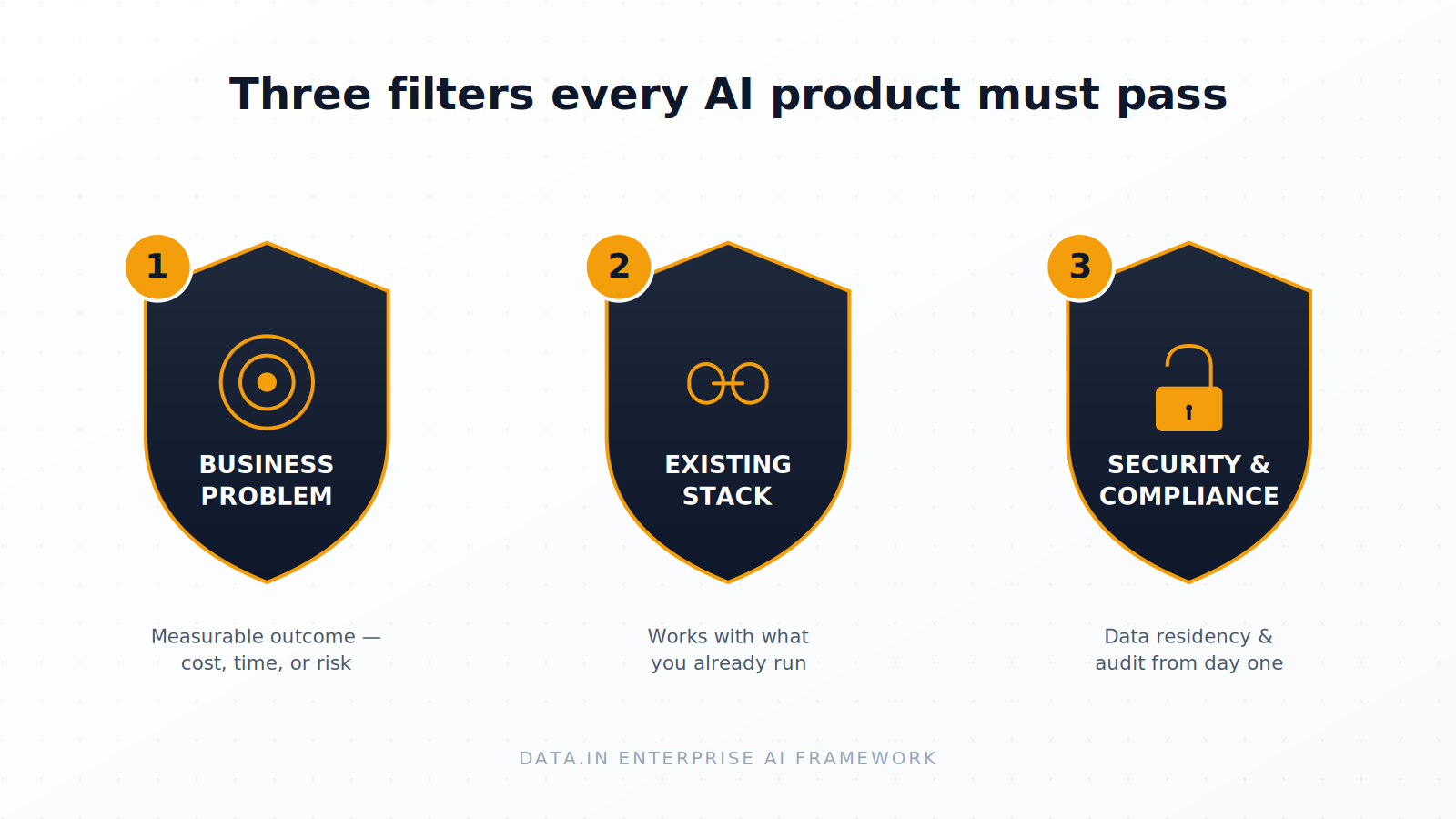
When we build AI Products at Data.in, we start with three filters:
- It must solve a measurable business problem. Cost saved, time saved, error rate reduced — something you can put a number against.
- It must work inside your existing stack. No "rip and replace". No wishful integration assumptions.
- It must respect data residency, compliance, and security from day one. Especially for BFSI and government clients.
If a project can't pass all three, we don't take it on. That single filter has saved our customers crores in failed pilots — and is one reason CTOs keep coming back to us for more AI Business Services.
How Data.in approaches AI product development
We're not a startup that woke up after ChatGPT and rebranded as an "AI technologies company". Data.in is part of the Data Ingenious group — the people behind XgenPlus, India's largest enterprise email platform with over 50 million users across 200+ deployments at organisations like BSNL, HAL, and Air India.
Two and a half decades of doing enterprise software development the hard way taught us something most newer AI based company players are still figuring out: the AI is the easy part. Putting it into production is where everything breaks.
So our process is shaped less like a Silicon Valley demo team and more like a senior engineering team that has seen real systems break in production at 3 a.m. on a Sunday.
Step-by-step AI product development process
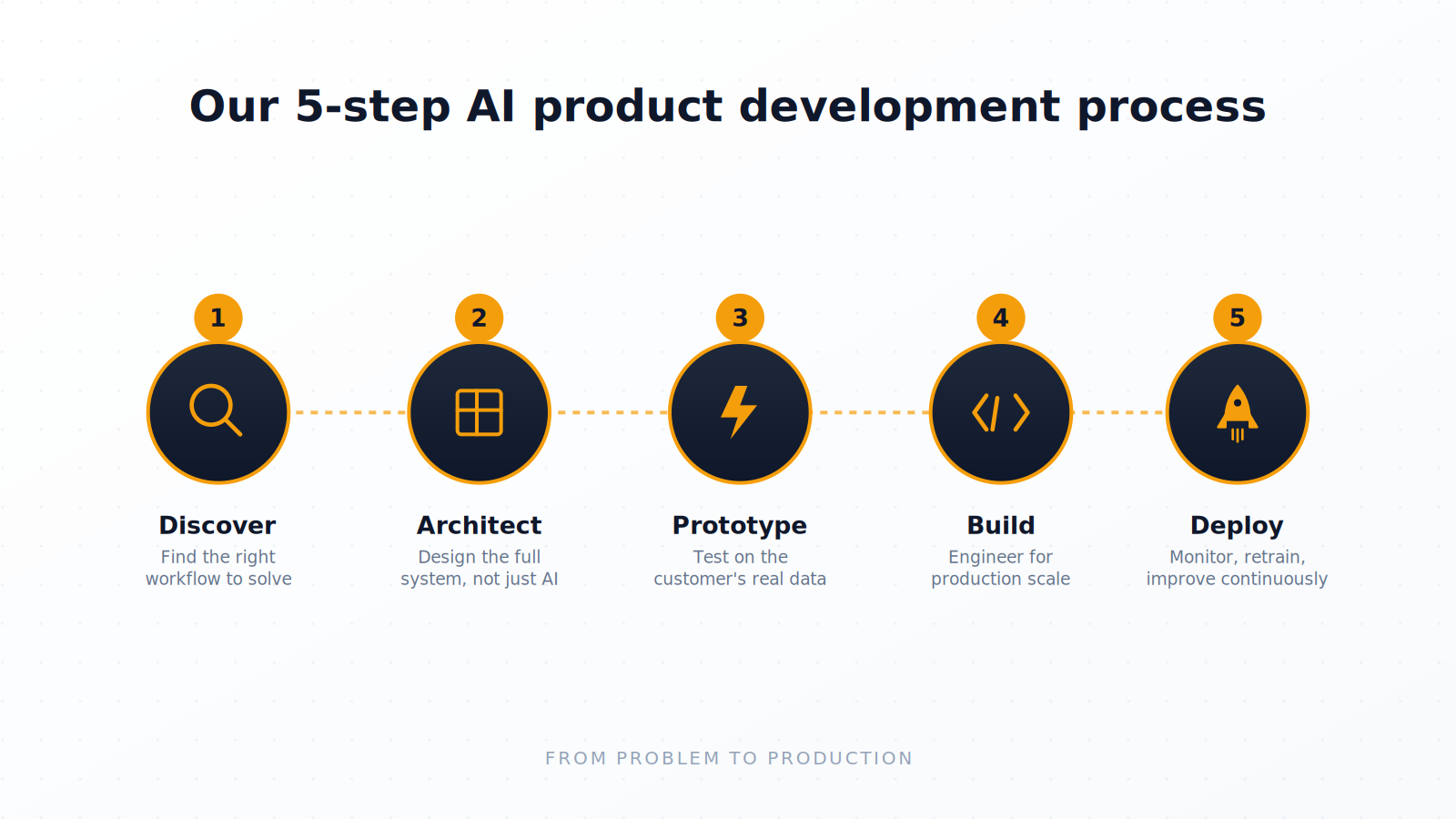
Here is how a typical AI engagement runs at Data.in.
Step 1: Problem discovery, not solution selling
Every project starts with a workshop. No slide decks. No "AI capability matrix". Just our engineers, your team, and a whiteboard.
The goal is to find the one workflow where AI can save the most time, money, or risk — and to be honest about whether AI is even the right answer. Sometimes a small piece of automation, a smart bit of software programming, or clean website development solves the problem better than any model.
Step 2: Architecture before algorithms
Before we write a single line of model code, we design the full system — data pipelines, integration points, security boundaries, fallback paths.
This is where most AI projects collapse. A model that gives 95% accuracy in a Jupyter notebook is useless if it can't talk to your core banking system, or if it goes down whenever a third-party API slows down.
Our team has deep experience across web development, software development, and IT software development — Java, .NET, PHP, Python, Node.js, and modern web stacks. That breadth matters because real AI Products are not notebooks; they are full-stack applications with real users and real SLAs.
Step 3: Prototype with real data
We do not build with toy datasets. Within two weeks, we get the model running on a sample of the customer's actual data — properly anonymised and inside their environment.
This kills surprises early. Every enterprise dataset has its own ghosts: messy formats, unreliable timestamps, mixed languages, free-text fields full of typos. Catching these in week two is cheap. Catching them in month six after a six-figure investment is not.
Step 4: Build, integrate, and harden
Now the real engineering begins.
This is where AI development meets website development, web dev, and backend systems. We build the model serving layer, integrate with the customer's existing applications, set up monitoring, write the runbooks for the ops team, and harden everything against the realities of production traffic.
We also use modern AI-assisted coding workflows internally — what some teams now call vibe coding, where engineers pair with AI assistants to write and review code at much higher velocity. It lets our small senior teams ship at the speed of much larger ones, without losing the discipline that enterprise dev website work demands.
Step 5: Deploy, measure, improve
Day one is not the end — it is the start of the most important phase.
Every AI product we ship comes with built-in monitoring for accuracy drift, latency, cost, and user feedback. We review these numbers weekly with the customer for the first quarter, then monthly. If a model drifts, we retrain. If usage patterns shift, we adapt.
This is the part most vendors skip. It is also the part that decides whether an AI product survives or dies in production.
Key technologies we use to build enterprise AI Products
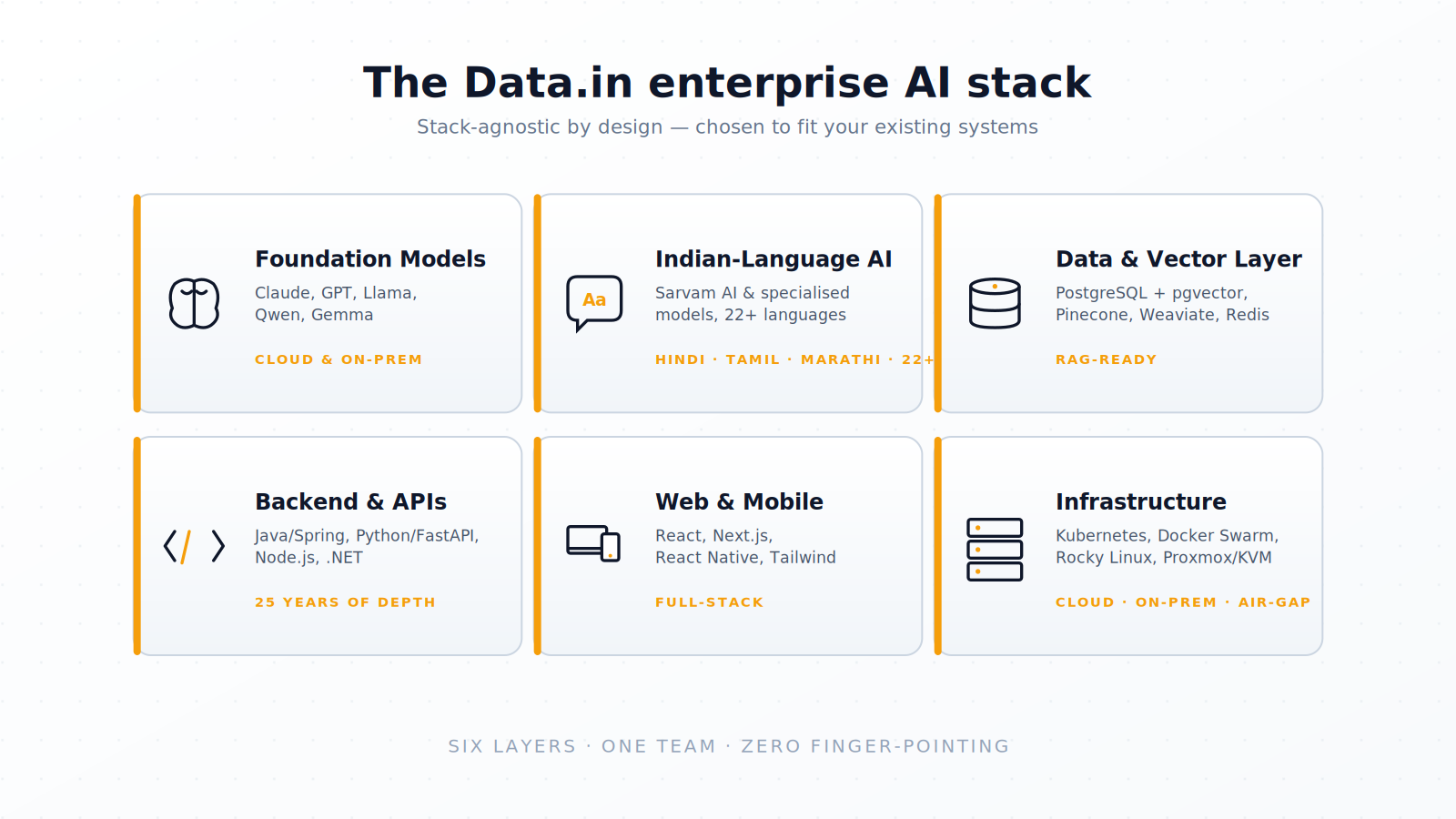
We are deliberately stack-agnostic, because every enterprise has a different reality. But our toolbox typically includes:
- Foundation models: Claude, GPT, and open-source models like Llama, Qwen, and Gemma for on-premise needs
- Indian-language AI: Sarvam AI and similar specialised models for Hindi, Tamil, Telugu, Marathi, Bengali, and other regional Indian languages
- Vector databases: pgvector, Pinecone, Weaviate for retrieval-augmented generation (RAG)
- Backend frameworks: Java (Spring), Python (FastAPI), Node.js, .NET — chosen based on the customer's existing stack
- Frontend & mobile: React, Next.js, React Native — clean, modern interfaces across web and app
- Infrastructure: Kubernetes, Docker Swarm, bare-metal Rocky Linux, Proxmox/KVM — including fully on-premise setups for BFSI and government clients
- Data layer: PostgreSQL, MySQL, Redis, NFS, S3-compatible object storage
For customers that need air-gapped deployments, we also build with fully on-premise small language models — no cloud calls, no data leaving the server, full audit logs. This is one of the strongest reasons enterprise leaders rate us among the best AI services in India.
Real use cases: AI Products we have actually shipped
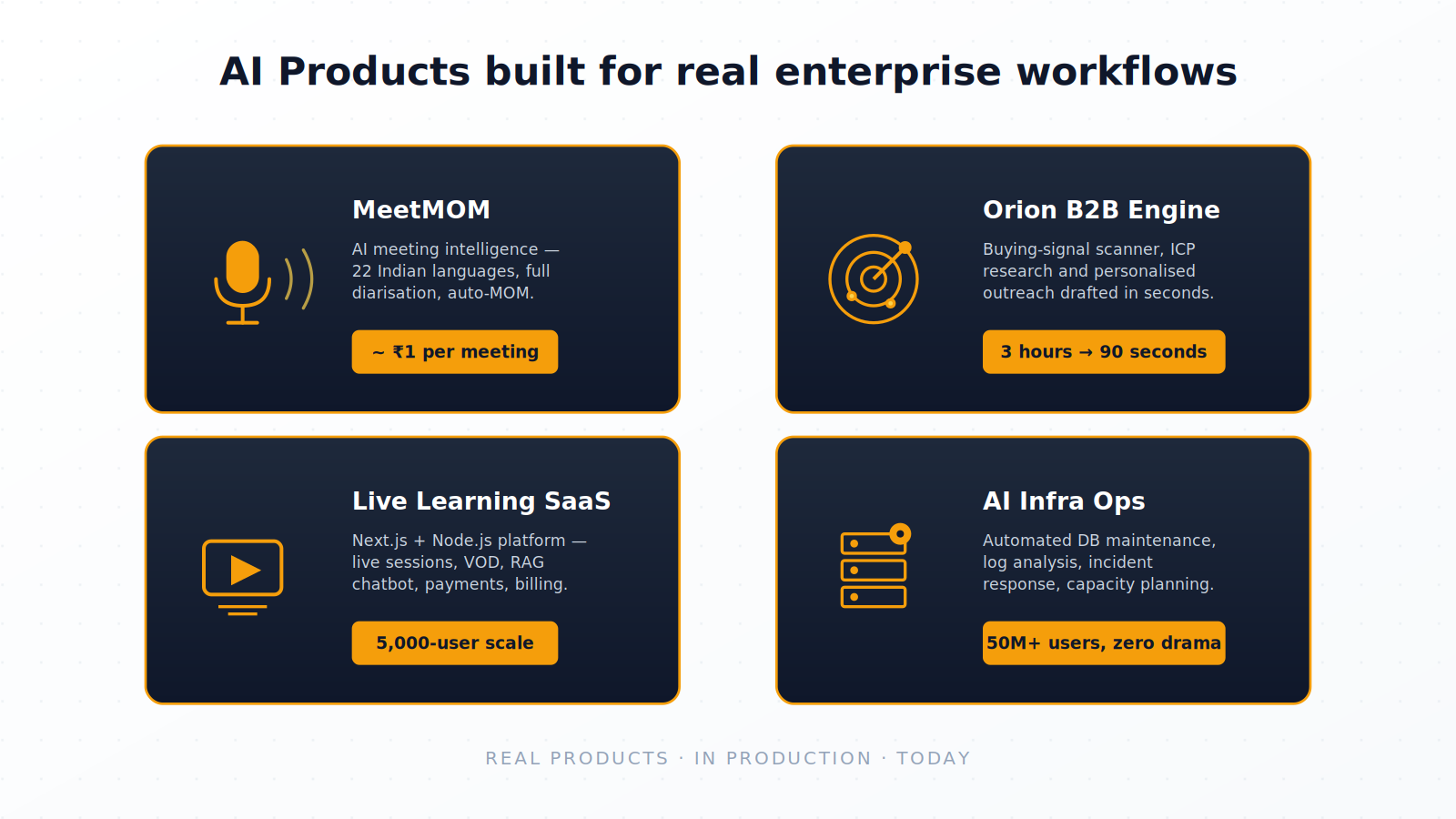
Talk is cheap. Here is what real enterprise AI looks like in production.
A meeting intelligence product for an enterprise email platform
We built MeetMOM — a meeting recorder and minutes-of-meeting generator integrated into an enterprise email and collaboration platform. It handles 22 Indian languages including Hinglish, runs full speaker diarisation, and generates structured minutes automatically. Cost per meeting: roughly one rupee. The same workflow done manually was costing customers 30–40 minutes of an executive's time.
An AI-powered B2B intelligence engine
For our internal go-to-market system, we built Orion — an agent that monitors WhatsApp, email, and CRM signals to identify buying intent, research accounts, and draft personalised outreach. What used to take a sales rep three hours per prospect now takes ninety seconds.
A live learning and wellness SaaS platform
For a global wellness organisation, we built a Next.js + Node.js platform with live video sessions, video-on-demand courses, and an AI-powered RAG chatbot trained on the organisation's published material — with proper subscription billing, multilingual support, and 5,000-user scale. End-to-end software development, not a wrapper.
Infrastructure-grade AI ops
Behind the scenes, we run AI-assisted ops on production systems handling tens of millions of users — automating database maintenance, log analysis, security incident response, and capacity planning. This is the unsexy but high-value side of AI for Business.
Benefits of AI Products for enterprises
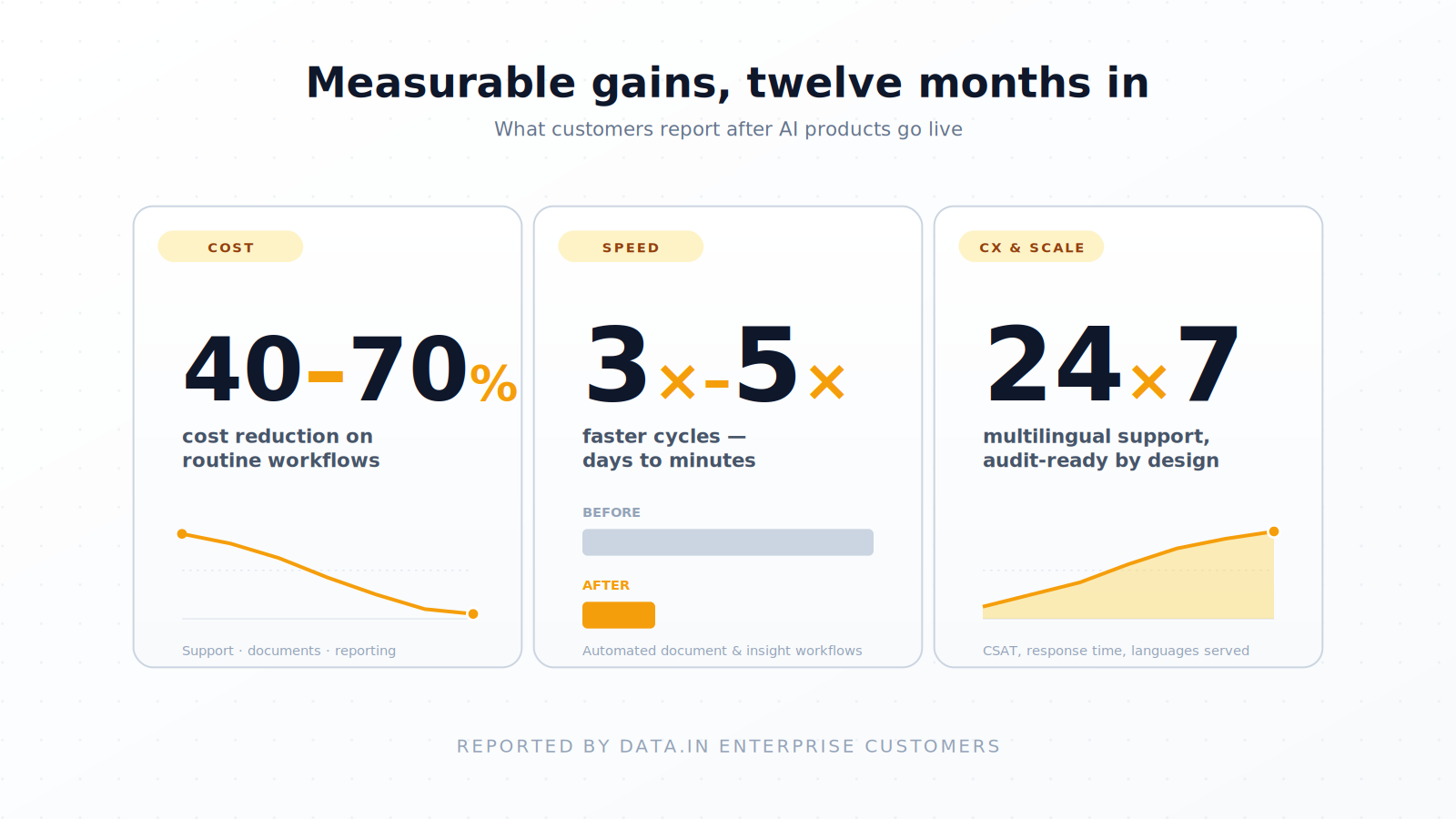
When AI Products are built right, the gains compound.
- Cost reduction: Routine workflows like support, document processing, and reporting drop in cost by 40–70%.
- Speed: Cycle times that used to take days now finish in minutes.
- Better decisions: Decision-makers get clean, real-time insights instead of stale weekly reports.
- Higher employee leverage: Your best people spend their time on judgement work, not data entry.
- Customer experience: Faster responses, in the customer's own language, around the clock.
- Compliance and audit: Every AI action is logged, traceable, and reviewable.
These aren't hypothetical numbers. They are what our customers report twelve months after deployment.
Why enterprise leaders choose Data.in
There are plenty of vendors selling AI today. Here is why CTOs, founders, and enterprise leaders keep choosing Data.in as their AI Business Services partner:
1. 25+ years of enterprise track record
We have shipped software to banks, telcos, government bodies, and Fortune 500 customers since long before AI was fashionable. Stability matters when your AI product is sitting inside a system 50 million people depend on.
2. Deep India expertise
Indian-language AI, BFSI compliance, government data residency, regional infrastructure — we don't outsource any of it. We have built it ourselves, multiple times, across multiple states.
3. Full-stack capability under one roof
We handle AI, backend, frontend, mobile, DevOps, and on-premise infrastructure from a single team. No finger-pointing between vendors when something breaks.
4. Honest engagement
We say no to projects that won't work, and we tell customers when AI is the wrong tool. That honesty is one reason our average customer relationship is over 10 years long.
5. Production discipline
We do not ship pilots. We ship production systems with SLAs, monitoring dashboards, and a phone number you can call at 3 a.m.
If you are evaluating the best AI Tools or best AI services for your enterprise, the right question isn't which model is cleverest. It is which partner can keep that model running reliably for the next five years.
The future of AI in the enterprise
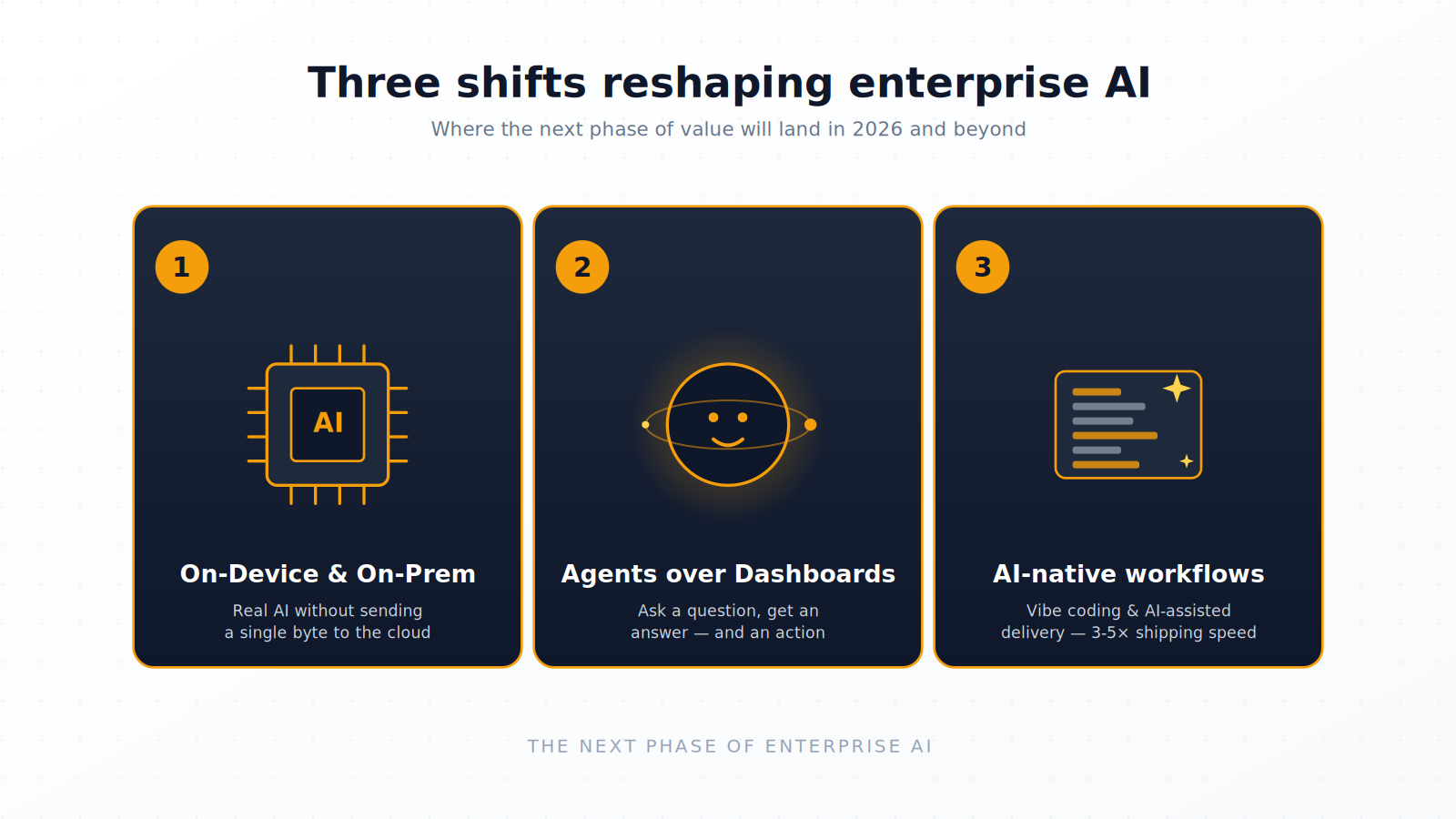
Three shifts are reshaping enterprise AI in 2026 and beyond:
1. On-device and on-premise AI is going mainstream
Smaller, smarter open-source models now run on regular CPUs and even on smartphones. For regulated industries, this is a game-changer — proper AI without sending a single byte to the cloud.
2. AI agents are replacing dashboards
Instead of staring at reports, executives will ask questions and get answers — with the AI taking action across CRM, ERP, and internal tools on their behalf.
3. AI-native workflows are reshaping how software gets built
From product specs to code review, AI is now embedded in every step of modern software development and IT software development. Teams that adopt this well will out-ship teams that don't, by a factor of 3 to 5x.
The companies that thrive will be the ones that treat AI not as a magic feature, but as a serious engineering discipline. The ones that don't will be left holding expensive PowerPoint slides.
Conclusion: AI is now an engineering problem, not a science experiment
The hype cycle around AI has done one good thing — it has forced every enterprise to take the technology seriously. But the next phase of value will go to companies that move past demos and into real production AI Products.
That is the work we do at Data.in. Not vapourware. Not "AI strategy". Real, working, measurable AI Products that solve enterprise problems and run in production for years.
If you are a CTO, founder, or enterprise leader exploring how AI can change your business, we'd love to talk.