

Introduction:
Software development has changed dramatically over the last few years. Development teams are shipping updates faster than ever, working across distributed environments, and managing increasingly complex codebases. While speed has become a competitive advantage, maintaining code quality, identifying security risks, and ensuring high application performance remain significant challenges.
Traditional manual code reviews are valuable, but they often struggle to keep pace with modern development cycles. Developers spend countless hours reviewing pull requests, finding bugs, fixing security vulnerabilities, and optimizing performance before deployment. As projects grow larger, this process becomes time-consuming, inconsistent, and expensive.
This is where AI Code Analysis is transforming software development.
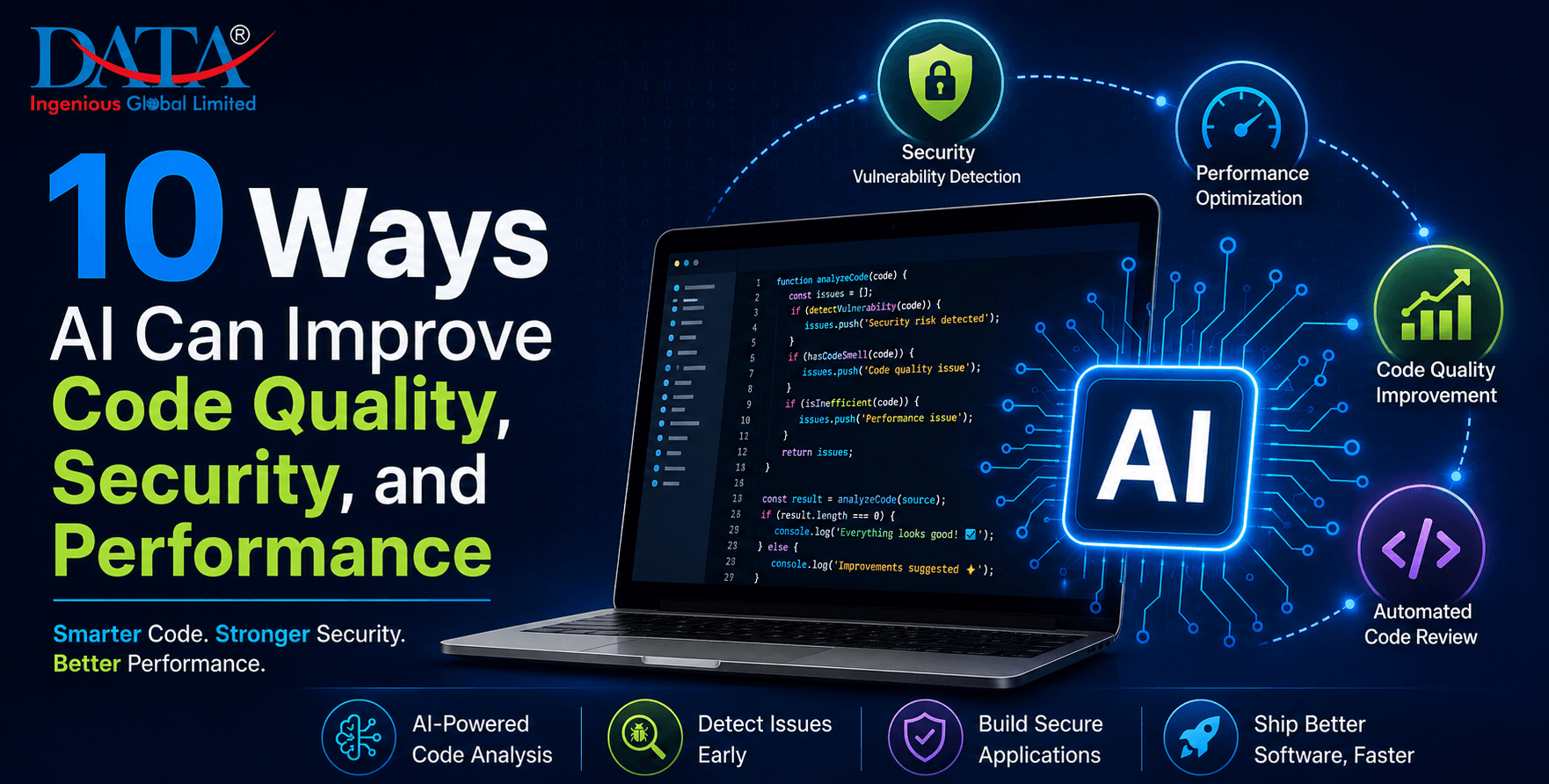
Artificial intelligence is no longer just helping developers write code—it is helping them write better, safer, and more efficient code. AI-powered tools can review thousands of lines of code within minutes, identify hidden vulnerabilities, recommend improvements, and continuously monitor code quality throughout the Software Development Lifecycle (SDLC).
Whether you're a startup building your first product or an enterprise managing millions of lines of code, AI-driven code analysis has become an essential part of modern DevSecOps.
In this article, we'll explore ten practical ways AI improves code quality, security, and application performance—and why businesses are increasingly adopting AI-powered code analysis solutions.
Why AI Code Analysis Is Becoming Essential
Software teams today face multiple challenges simultaneously. Applications are expected to be secure, scalable, fast, and bug-free while development timelines continue to shrink.
Manual code reviews often suffer from:
- Human error
- Reviewer fatigue
- Inconsistent coding standards
- Missed security vulnerabilities
- Delayed releases
AI addresses these problems by continuously analyzing source code using machine learning, static code analysis, and intelligent pattern recognition.
Unlike traditional static analyzers that rely only on predefined rules, modern AI systems learn from millions of coding examples and industry best practices to deliver more meaningful recommendations.
The result is faster development, fewer production bugs, stronger security, and better software quality.
1. AI Detects Bugs Before They Reach Production
One of the biggest advantages of AI Code Analysis is early bug detection.
Many software defects originate during development but remain unnoticed until testing or production. Fixing bugs after deployment is significantly more expensive than identifying them during coding.
AI-powered code analysis scans source code in real time and detects:
- Logic errors
- Incorrect variable usage
- Memory leaks
- Null pointer exceptions
- Infinite loops
- Dead code
- Resource leaks
Instead of waiting for QA teams or users to discover problems, developers receive intelligent recommendations while writing code.
This proactive approach reduces debugging time and significantly improves software reliability.
2. AI Makes Code Reviews Faster and More Consistent
Manual AI Code Review has long been considered one of the best software engineering practices. However, traditional reviews depend heavily on reviewer experience, availability, and consistency.
AI-powered Automated Code Review solves these challenges.
Instead of spending hours reviewing repetitive issues, AI automatically checks:
- Coding standards
- Naming conventions
- Duplicate code
- Complexity
- Maintainability
- Best practices
Developers can then focus on business logic and architectural decisions rather than formatting and minor mistakes.
The result is:
- Faster pull request approvals
- Higher review consistency
- Better collaboration
- Reduced developer workload
AI doesn't replace human reviewers—it makes them significantly more productive.
3. AI Improves Overall Code Quality
Maintaining high-quality software requires much more than writing functional code.
Modern applications need readable, maintainable, scalable, and reusable code.
This is where Code Quality Improvement becomes a continuous process rather than a one-time activity.
AI identifies quality issues such as:
- Long methods
- High cyclomatic complexity
- Code duplication
- Poor modularization
- Tight coupling
- Low cohesion
Rather than simply pointing out problems, advanced AI systems explain why the issue matters and recommend cleaner alternatives.
Over time, teams build healthier codebases that are easier to maintain and scale.
4. AI Finds Security Vulnerabilities Earlier
Cybersecurity threats continue to evolve, making application security one of the highest priorities for software teams.
Unfortunately, many vulnerabilities remain hidden inside application code until attackers discover them.
AI Security Vulnerability Detection helps identify security weaknesses during development.
AI scans applications for risks including:
- SQL Injection
- Cross-Site Scripting (XSS)
- Cross-Site Request Forgery (CSRF)
- Hardcoded credentials
- Authentication flaws
- Authorization issues
- Unsafe API usage
- Insecure encryption
Finding vulnerabilities before deployment dramatically reduces security risks while lowering remediation costs.
For organizations following DevSecOps practices, AI becomes an essential security layer integrated directly into CI/CD pipelines.
5. AI Strengthens Static Code Analysis
Traditional Static Code Analysis tools have existed for years, but they often produce large numbers of false positives.
Developers eventually begin ignoring alerts.
AI improves static analysis by understanding context rather than simply applying predefined rules.
Modern AI-powered analyzers can distinguish between:
- Real vulnerabilities
- Safe implementations
- Context-aware exceptions
- Framework-specific patterns
This significantly improves detection accuracy while reducing alert fatigue.
Developers receive actionable recommendations instead of overwhelming lists of warnings.
6. AI Optimizes Application Performance
Software that functions correctly isn't necessarily efficient.
Performance issues can increase infrastructure costs, reduce customer satisfaction, and impact business growth.
AI helps with Code Performance Optimization by identifying inefficient code patterns such as:
- Slow database queries
- Unnecessary loops
- Memory-intensive operations
- Expensive API calls
- Thread blocking
- Resource bottlenecks
Rather than relying solely on runtime profiling, AI predicts performance problems during development.
This proactive optimization leads to faster applications, lower cloud costs, and improved user experience.
7. AI Accelerates Software Development
Development teams constantly balance quality with speed.
The pressure to release features quickly often results in technical debt.
AI for Software Development helps developers write better code faster by:
- Suggesting improvements instantly
- Explaining code quality issues
- Identifying reusable code
- Recommending secure coding practices
- Reducing repetitive review tasks
Instead of slowing development, AI enables teams to maintain high quality while accelerating release cycles.
Developers spend less time fixing avoidable mistakes and more time building valuable features.
8. AI Supports Secure DevSecOps Workflows
Modern organizations increasingly integrate security directly into the software development lifecycle.
This approach, known as DevSecOps, requires continuous monitoring rather than periodic security testing.
AI Application Security solutions continuously inspect source code throughout development.
Instead of waiting for penetration testing near release, AI monitors every commit and every pull request.
Benefits include:
- Continuous vulnerability scanning
- Faster remediation
- Secure coding recommendations
- Compliance support
- Reduced attack surface
Security becomes everyone's responsibility—not just the security team's.
9. AI Helps Maintain Large Enterprise Codebases
Enterprise software often contains millions of lines of legacy code.
Maintaining these systems becomes increasingly difficult as teams change and documentation becomes outdated.
AI-powered analysis helps organizations understand complex codebases by:
- Detecting technical debt
- Mapping dependencies
- Highlighting risky changes
- Identifying obsolete code
- Suggesting modernization opportunities
This enables enterprises to confidently maintain, upgrade, and refactor applications without introducing unnecessary risks.
10. AI Provides Continuous Learning for Development Teams
One overlooked benefit of AI Code Analysis is knowledge sharing.
Every code review becomes a learning opportunity.
Instead of simply marking code as incorrect, AI explains:
- Why the issue matters
- Best practices
- Industry standards
- Alternative implementations
- Security implications
Junior developers learn faster while experienced developers stay aligned with evolving standards.
Over time, the entire engineering team improves its coding practices naturally.
The Business Benefits of AI-Powered Code Analysis
Organizations adopting AI-powered code analysis experience measurable improvements across engineering teams.
Beyond technical advantages, businesses benefit from faster release cycles, reduced maintenance costs, improved customer satisfaction, and stronger compliance with security standards.
Development managers gain greater visibility into software quality, while engineering teams spend less time fixing defects and more time building innovative features.
For businesses operating in regulated industries such as banking, healthcare, government, and enterprise SaaS, AI-driven analysis also supports secure software delivery and reduces compliance risks.
Why Modern Businesses Are Investing in AI Code Analysis
Artificial intelligence has moved beyond being a productivity tool. It has become a strategic advantage for software engineering teams.
Companies adopting AI-powered development workflows are able to:
- Release products faster
- Improve software quality
- Reduce security vulnerabilities
- Lower technical debt
- Improve developer productivity
- Build scalable applications with confidence
As AI models continue to evolve, code analysis will become even more intelligent, context-aware, and deeply integrated into every stage of software development.
Organizations that embrace AI today will be better positioned to deliver secure, high-performing applications tomorrow.
How CodeSureX Helps Organizations Build Better Software
As software projects become larger and more complex, engineering teams need intelligent tools that go beyond traditional static analysis. This is where CodeSureX helps development teams improve software quality without slowing down releases.
CodeSureX is an AI-Powered Code Analysis Tool designed to strengthen code quality, automate reviews, detect security vulnerabilities, and identify performance bottlenecks throughout the development lifecycle. Instead of relying solely on manual reviews, teams can continuously scan their codebase and receive actionable recommendations before issues reach production.
Whether you're building enterprise applications, SaaS platforms, or modern web and mobile solutions, CodeSureX supports secure, scalable, and efficient software development by helping developers write cleaner, safer, and more maintainable code.
By integrating AI-powered code analysis into everyday workflows, organizations can reduce technical debt, improve collaboration, and accelerate software delivery with greater confidence.
Conclusion
Software quality is no longer just about writing code that works. Modern applications must also be secure, scalable, maintainable, and optimized for performance.
AI Code Analysis enables development teams to achieve these goals by identifying bugs earlier, automating code reviews, strengthening security, improving maintainability, and optimizing application performance throughout the development lifecycle.
Rather than replacing developers, AI acts as an intelligent engineering partner—helping teams deliver higher-quality software faster while reducing risk and development costs.
As AI continues to reshape software engineering, organizations that invest in AI-powered code analysis today will be better equipped to build reliable, secure, and future-ready applications.
Explore CodeSureX to discover how AI-driven code analysis can help your engineering teams deliver cleaner, safer, and more reliable software—faster.